"About 150 years before Eunice came to Sugar Beach, two men set in motion the series of events that would lead to the day that I, a privileged almost-eight-year-old Congo girl, acquired my new sister, Eunice, a not-so-privileged eleven-year-old Bassa girl.
The chain started by those two men would eventually separate me from black people in America, and at the same time separate me from most black people in Africa. Their names were Elijah Johnson and Randolph Cooper. They were my great-great-great-great-grandfathers. At the turn of the nineteenth century in pre-Civil War America, they both belonged to that nebulous class of freed-blacks-once-removed from southern plantations.
When presented the choice between America and Africa, they chose Africa. Because of that choice, I would not grow up, 150 years later, as an American black girl, weighed down by racial stereotypes about welfare queens. Nor would I have to deal with the burdens of a sub-Saharan girl, with a life expectancy of about 40 years, yanked out of school at the age of eleven so I could fetch water and cook over a coal pot and bear babies barely younger than myself.
Instead, those men handed down to me a one-in-a-million lottery ticket: birth into what passed for the landed gentry upper class of Africa's first independent country, Liberia. None of that American post-civil war/civil rights movement baggage to bog me down with any inferiority complex about whether I was as good as white people. No European garbage to have me wondering whether some British colonial master was somehow better than me. Who needs to struggle for equality? Let everybody else try to equal me" P. 29
Showing posts with label Life. Show all posts
Showing posts with label Life. Show all posts
Wednesday, December 03, 2008
A Great Book by Helene Cooper of the New York Times
The House at Sugar Beach: In Search of a Lost African Childhood


Saturday, April 19, 2008
The Groupings of Life
From the book 'Your Inner Fish: A Journey into the 3.5 Billion-Year History of the Human Body' P. 7 - 9.
"That a column of rocks has a progression of fossil species probably comes as no surprise. Less obvious is that we can make detailed predictions about what the species in each layer might actually look like by comparing them with species of animals that are alive today; this information helps us to predict the kinds of fossils we find in ancient rock layers. In fact, the fossil sequences in the world's rocks can be predicted by comparing ourselves with the animals at our local zoo or aquarium.
How can a walk through the zoo help us predict where we should look in the rocks to find fossils? A zoo offers a great variety of creatures that are all distinct in many ways. But let's not focus on what makes them distinct; to pull off our prediction, we need to focus on what different creatures share. We can then use the features common to all species to identify groups of creatures with similar traits. All the living things can be organized and arranged like a set of Russian nesting dolls, with smaller groups of animals comprised in bigger groups of animals. When we do this, we discover something very fundamental about nature.
Every species in the zoo and aquarium has a head and two eyes. Call these species 'Everythings.' A subset of the creatures with a head and two eyes has limbs. Call the limbed species 'Everythings with limbs.' A subset of these headed and limbed creatures has a huge brain, walks on two feet, and speaks. That subset is us, humans. We could, of course, use this way of categorizing things to make many more subsets, but even this threefold division has predictive power.
The fossils inside the rocks of the world generally follow this order, and we can put it to use in designing new expeditions. To use the example above, the first member of the group 'Everythings,' a creature with a head and two eyes, is found in the fossil record well before the first 'Everythings with limbs.' More precisely, the first fish (a card-carrying member of the 'Everythings') appears before the first amphibian(an 'Everything with limbs"). Obviously, we refine this by looking at more kinds of animals and many more characteristics that groups of them share, as well as by assessing the actual age of rocks themselves.
...
The order of fossils in the world's rocks is powerful evidence of our connections to the rest of life. If, digging in 600-million-year-old rocks, we found the earliest jellyfish lying next to the skeleton of a woodchuck, then we would have to rewrite our texts. That woodchuck would have appeared earlier in the fossil record than the first mammal, reptile, or even fish--before even the first worm. Moreover, our ancient woodchuck would tell us that much of what we think we know about the history of the earth and life on it is wrong. Despite more than 150 years of people looking for fossils--on every continent of earth and in virtually every rock layer that is accessible--this observation has never been made."
"That a column of rocks has a progression of fossil species probably comes as no surprise. Less obvious is that we can make detailed predictions about what the species in each layer might actually look like by comparing them with species of animals that are alive today; this information helps us to predict the kinds of fossils we find in ancient rock layers. In fact, the fossil sequences in the world's rocks can be predicted by comparing ourselves with the animals at our local zoo or aquarium.
How can a walk through the zoo help us predict where we should look in the rocks to find fossils? A zoo offers a great variety of creatures that are all distinct in many ways. But let's not focus on what makes them distinct; to pull off our prediction, we need to focus on what different creatures share. We can then use the features common to all species to identify groups of creatures with similar traits. All the living things can be organized and arranged like a set of Russian nesting dolls, with smaller groups of animals comprised in bigger groups of animals. When we do this, we discover something very fundamental about nature.
Every species in the zoo and aquarium has a head and two eyes. Call these species 'Everythings.' A subset of the creatures with a head and two eyes has limbs. Call the limbed species 'Everythings with limbs.' A subset of these headed and limbed creatures has a huge brain, walks on two feet, and speaks. That subset is us, humans. We could, of course, use this way of categorizing things to make many more subsets, but even this threefold division has predictive power.
The fossils inside the rocks of the world generally follow this order, and we can put it to use in designing new expeditions. To use the example above, the first member of the group 'Everythings,' a creature with a head and two eyes, is found in the fossil record well before the first 'Everythings with limbs.' More precisely, the first fish (a card-carrying member of the 'Everythings') appears before the first amphibian(an 'Everything with limbs"). Obviously, we refine this by looking at more kinds of animals and many more characteristics that groups of them share, as well as by assessing the actual age of rocks themselves.
...
The order of fossils in the world's rocks is powerful evidence of our connections to the rest of life. If, digging in 600-million-year-old rocks, we found the earliest jellyfish lying next to the skeleton of a woodchuck, then we would have to rewrite our texts. That woodchuck would have appeared earlier in the fossil record than the first mammal, reptile, or even fish--before even the first worm. Moreover, our ancient woodchuck would tell us that much of what we think we know about the history of the earth and life on it is wrong. Despite more than 150 years of people looking for fossils--on every continent of earth and in virtually every rock layer that is accessible--this observation has never been made."
Friday, April 18, 2008
Does Certainty exist?
"I am certain there is too much certainty in the world." -- Michael Crichton
"The most educated person in the world has to admit he or she knows less and less ... but knows less and less about more and more." God is Not Great- how religion poisons everything P. 9
"The more I know, the less I understand
And all the things I thought I figured out, I have to learn again" - Don Henley
"… the world is funnier than you think. And the more you think about it, the funnier it gets. Close inspection reveals the ironies, contradictions, and confusions that make life interesting, but also frustrating.
...
The more man thinks, the slower he moves. Thought uncovers the limitations of his plans. Exploring the possibilities, he sees yet more potential outcomes, a greater number of problems … and he increasingly recognizes how little he actually knows.
" - Financial Reckoning Day P. 2
“You don’t know what tomorrow will bring. Every day you research and strategize about your next move. Just when you think you have a handle on things, something turns your plans upside-down. When that happens you realize you know nothing.” Oil on the Brain P. 137
"The most educated person in the world has to admit he or she knows less and less ... but knows less and less about more and more." God is Not Great- how religion poisons everything P. 9
"The more I know, the less I understand
And all the things I thought I figured out, I have to learn again" - Don Henley
"… the world is funnier than you think. And the more you think about it, the funnier it gets. Close inspection reveals the ironies, contradictions, and confusions that make life interesting, but also frustrating.
...
The more man thinks, the slower he moves. Thought uncovers the limitations of his plans. Exploring the possibilities, he sees yet more potential outcomes, a greater number of problems … and he increasingly recognizes how little he actually knows.
" - Financial Reckoning Day P. 2
“You don’t know what tomorrow will bring. Every day you research and strategize about your next move. Just when you think you have a handle on things, something turns your plans upside-down. When that happens you realize you know nothing.” Oil on the Brain P. 137
Friday, April 11, 2008
How do we KNOW the things we believe?
“Each of us has life view. For most of us, our view results more from where we were born, who our parents were, and what schools we attended than a careful examination of issues. Yet our life view influences every thought we have, every word we speak, and every action we take.” - The Man in the Mirror P. 38
"That illustrates what the psychoanalysts so much emphasize -- the immensely stronger hold upon us that our very early associations have than those of later times." - Bertrand Russell
"Systematic thinking is apparently a comparatively late development in human experience; it has not played any great part in human life until within the last 3,000 years. And even today those who really control and order their thoughts are but a small minority of mankind. Most of the world still lives by imagination and passion." A Short History of the World, H.G. Wells P. 37
"We want to stand upon our own feet and look fair and square at the world -- its good facts, its bad facts, its beauties, and its ugliness; see the world as it is and be not afraid of it. Conquer the world by intelligence and not merely by being slavishly subdued by the terror that comes from it. ... We ought to stand up and look the world frankly in the face. We ought to make the best we can of the world, and if it is not so good as we wish, after all it will still be better than what these others have made of it in all these ages. A good world needs knowledge, kindliness, and courage; it does not need a regretful hankering after the past or a fettering of the free intelligence by the words uttered long ago by ignorant men. It needs a fearless outlook and a free intelligence. It needs hope for the future, not looking back all the time toward a past that is dead, which we trust will be far surpassed by the future that our intelligence can create." - Bertrand Russell
"That illustrates what the psychoanalysts so much emphasize -- the immensely stronger hold upon us that our very early associations have than those of later times." - Bertrand Russell
"Systematic thinking is apparently a comparatively late development in human experience; it has not played any great part in human life until within the last 3,000 years. And even today those who really control and order their thoughts are but a small minority of mankind. Most of the world still lives by imagination and passion." A Short History of the World, H.G. Wells P. 37
"We want to stand upon our own feet and look fair and square at the world -- its good facts, its bad facts, its beauties, and its ugliness; see the world as it is and be not afraid of it. Conquer the world by intelligence and not merely by being slavishly subdued by the terror that comes from it. ... We ought to stand up and look the world frankly in the face. We ought to make the best we can of the world, and if it is not so good as we wish, after all it will still be better than what these others have made of it in all these ages. A good world needs knowledge, kindliness, and courage; it does not need a regretful hankering after the past or a fettering of the free intelligence by the words uttered long ago by ignorant men. It needs a fearless outlook and a free intelligence. It needs hope for the future, not looking back all the time toward a past that is dead, which we trust will be far surpassed by the future that our intelligence can create." - Bertrand Russell
Depressing? Maybe! Maybe Not!
"... if you accept the ordinary laws of science, you have to suppose that human life and life in general on this planet will die out in due course: it is a stage in the decay of the solar system; at a certain stage of decay you get the sort of conditions of temperature and so forth which are suitable to protoplasm, and there is life for a short time in the life of the whole solar system. You see in the moon the sort of thing to which the earth is tending -- something dead, cold, and lifeless.
I am told that that sort of view is depressing, and people will sometimes tell you that if they believed that, they would not be able to go on living. Do not believe it; it is all nonsense. Nobody really worries about much about what is going to happen millions of years hence. Even if they think they are worrying much about that, they are really deceiving themselves. They are worried about something much more mundane, or it may merely be a bad digestion; but nobody is really seriously rendered unhappy by the thought of something that is going to happen to this world millions and millions of years hence. Therefore, although it is of course a gloomy view to suppose that life will die out -- at least I suppose we may say so, although sometimes when I contemplate the things that people do with their lives I think it is almost a consolation -- it is not such as to render life miserable. It merely makes you turn your attention to other things. " - Bertrand Russell
I am told that that sort of view is depressing, and people will sometimes tell you that if they believed that, they would not be able to go on living. Do not believe it; it is all nonsense. Nobody really worries about much about what is going to happen millions of years hence. Even if they think they are worrying much about that, they are really deceiving themselves. They are worried about something much more mundane, or it may merely be a bad digestion; but nobody is really seriously rendered unhappy by the thought of something that is going to happen to this world millions and millions of years hence. Therefore, although it is of course a gloomy view to suppose that life will die out -- at least I suppose we may say so, although sometimes when I contemplate the things that people do with their lives I think it is almost a consolation -- it is not such as to render life miserable. It merely makes you turn your attention to other things. " - Bertrand Russell
Sunday, March 23, 2008
Lest I forget I'm an Immigrant
"The violent upheavals of the twentieth century have made millions of people homeless in one traumatic uprooting after another. Exile, is of course, not simply a change of address. It is also spiritual dislocation. Anthropologists and psychologists tell us that displaced people feel lost in a universe that has suddenly become alien. Once the fixed point of home is gone, there is fundamental lack of orientation that makes everything seem relative and aimless. Cut off from the roots of their culture and identity, migrants and refugees can feel that they are somehow withering away and becoming insubstantial. Their world – inextricably linked with their unique place in the cosmos – has literally come to an end.” - The Spiral Staircase, P.23-24.
Wednesday, January 02, 2008
Thursday, August 03, 2006
20 Years ago today...
Remember the movie "Coming to America" with Eddie Murphy and Arsenio Hall? Well I have been thinking about that movie today.
Twenty years ago on this day I boarded a plane in Ethiopia and started my own "Coming to America" story. Actually it was a "Coming back to America" story since I was born in the U.S.A. But I was only there until about age three.
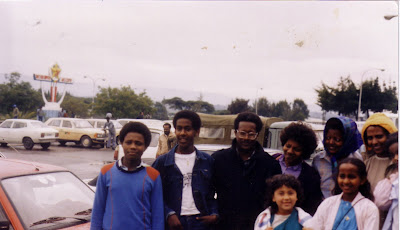
On the day I boarded that plane, I was 16 years old. Today, 20 years on, I look at a picture taken on that day at the airport with me, my family, and friends and I wonder:
Of course it is obvious that I did not have a clue about most of those questions! I was only sixteen after all.
All I cared about was, I was GOING TO AMERICA! The America I had seen in the movies at our friend Nancy's house. I was going to drink Coke out of cans and eat apples. I was going to go to McDonald's. I was going to see the snow.
What an idiot? Can you imagine wanting to see the snow?!!
Anyway, they have been a very interesting 20 years. By most traditional measures they have also been successful years.
As I look back, I can't help but be amazed by how fortunate I have been. I have received at least as much credit as I deserve, if not more, and I have not been blamed for more than I deserve. I realize that I have the best parents possible, a great wife that loves me, and my sisters are not bad either. The sisters are not used to me saying nice things about them, so I have to ease them into it.
So today is a special day for me. It is one of those days that marks a chapter in my life. I tend to think of my life so far as consisting of two parts -- Life Part I: "The Ethiopia Years" & Life Part II: "Coming to America - A 20 year journey."
And now it's on to Life Part III - Whatever that might bring.
Twenty years ago on this day I boarded a plane in Ethiopia and started my own "Coming to America" story. Actually it was a "Coming back to America" story since I was born in the U.S.A. But I was only there until about age three.
On the day I boarded that plane, I was 16 years old. Today, 20 years on, I look at a picture taken on that day at the airport with me, my family, and friends and I wonder:
- I wonder if I had any clue that it would be 12 years before I'd go back to visit
- I wonder what was going through my parents' minds that day
- I wonder if I had any idea how much the move would strain my family's relationship with me
- I wonder how different my life would be if there had not been the risk of the government picking up kids my age from the streets, putting a rifle in our hands, and sending us to fight in a civil war
- I wonder what happened to the thousands of Ethiopian kids my age who also had to make a similar trip
- I wonder if I had any clue about how interesting the next 20 years would be
Of course it is obvious that I did not have a clue about most of those questions! I was only sixteen after all.
All I cared about was, I was GOING TO AMERICA! The America I had seen in the movies at our friend Nancy's house. I was going to drink Coke out of cans and eat apples. I was going to go to McDonald's. I was going to see the snow.
What an idiot? Can you imagine wanting to see the snow?!!
Anyway, they have been a very interesting 20 years. By most traditional measures they have also been successful years.
As I look back, I can't help but be amazed by how fortunate I have been. I have received at least as much credit as I deserve, if not more, and I have not been blamed for more than I deserve. I realize that I have the best parents possible, a great wife that loves me, and my sisters are not bad either. The sisters are not used to me saying nice things about them, so I have to ease them into it.
So today is a special day for me. It is one of those days that marks a chapter in my life. I tend to think of my life so far as consisting of two parts -- Life Part I: "The Ethiopia Years" & Life Part II: "Coming to America - A 20 year journey."
And now it's on to Life Part III - Whatever that might bring.
Subscribe to:
Posts (Atom)